
Days of contract review, done in under a minute.
Contract Intelligence Copilot: AI contract review built on Claude and serverless AWS, for a global life sciences enterprise.
- Validate: every clause checked against the client's 10-clause standard.
- Compare: two vendor contracts side by side, with a recommendation on whose terms are stronger.
- Ask: plain-English questions, answered with the clause cited.
Claude reads all 150 pages, scores every clause against the standard and flags what needs a fix. Replay sped up; illustrative contract.
Meet our client
- Client
- Global Life Sciences Enterprise
- Industry
- Life Sciences & Enterprise Technology
- Market
- Global enterprise
In a nutshell
Built to speed up the integration of two life sciences businesses after an $18 billion carve-out merger. Teams upload a contract and get a structured, clause-by-clause review from Claude in minutes, with no contract lifecycle management (CLM) platform needed.
Review that doesn't scale
Contracts arrive faster than people can read them, and risks slip through.
Drag the timeline, or let it play.
- Contracts never stop coming: SOWs, MSAs and NDAs arrive constantly, and each must be checked before anyone signs.
- Manual review takes days: a lawyer reads every page, clause by clause. Slow and expensive.
- Results are inconsistent: different reviewers apply the standards unevenly.
- Missed risks surface too late: a liability gap or missing renewal opt-out becomes a problem only after signing.
Six requirements, all at once
Each requirement, written as a clause. Tap one to initial it.
- Real-world files: contracts arrive as PDF, DOCX or TXT, so all three had to work out of the box. Text-based PDFs work today. Scanned contracts need OCR, which is planned for Phase 3.
- Long documents: vendor proposals can approach 200 pages and still need a full read.
- Structured output: reviewers need statuses, fields and fixes they can act on, not free-form AI prose.
- Secure handling: enterprise contracts stay encrypted, with credentials kept out of the code.
- Fully serverless: nothing for the client to run or patch, and it scales on demand.
- Long-running analysis: big reviews take longer than a normal web request, so processing runs asynchronously, with real-time chat on top.
Upload a contract. Do one of three things.
Contract Intelligence Copilot: a fully serverless AI contract-review platform, built on Claude and deployed on AWS.
- Proposal Validator: upload one MSA or SOW and get a decision-ready review in minutes.
- Contract Comparison: upload two contracts and surface every material difference and risk.
- AI Chat: ask any question about a contract and get an answer that cites the clause.
- Document library: upload once to encrypted S3, then reuse the file across all three workflows.
Is a 150-page SOW safe to sign by Friday?
Drop the file in and watch Claude review it. Click any clause to see what the contract says and the fix.
- 1Upload the contract
- 2Claude reads every page
- 3Metadata extracted
- 4Clauses scored against the standard
- 5Fixes and vendor questions drafted
The real review of a 150-page document takes under 35 seconds. This replay is shortened.
- Metadata, extracted automatically: vendor, contract type, value, effective and expiry dates, duration.
- Clause-by-clause risk report: each clause rated GREEN (compliant), AMBER (needs negotiation) or RED (missing or non-compliant).
- A specific fix for every flagged clause, plus an executive summary and an overall risk rating.
- 3–5 follow-up questions generated automatically, ready to send to the vendor.
Two vendors, one engagement. Whose terms are stronger?
Upload both contracts and name the vendors. Claude reads both, clause by clause. Click a row for the negotiation tip, or ask the chat.
- A side-by-side winner table: who is stronger on each clause, with a risk level per row.
- A negotiation tip on every row, plus an overall recommendation and the top 3 things to push back on.
- Chat built into the same screen: any question about either contract, answered with the actual clause cited.
- One click to a draft negotiation letter for the weaker vendor, ready for legal to review.
- A verdict on terms, not on the vendor: the recommendation says whose contract terms are stronger. It does not assess the vendors themselves, so choosing one stays with the team.
- 10 clauses in the standard, 25 in the real comparison: the Validator checks one contract against the client's 10-clause standard. The comparison weighs two contracts against each other, clause by clause, so it is not limited to those ten: the real one under Proof covers 25 clauses.
- 1Upload. The vendor's contract goes into the document library once, as a PDF, DOCX or TXT file.
- 2Validate. Claude extracts the key terms and rates every clause against the client's 10-clause standard: GREEN, AMBER or RED, with a fix for each flagged clause.
- 3Triage. Procurement flags the high-risk items, so legal reads the flagged clauses, not every page.
- 4Ask. Reviewers question any clause in the AI Chat and get answers that cite the clause.
- 5Push back. The drafted follow-up questions go to the vendor. For two competing vendors, the comparison adds the top 3 points to negotiate and a draft negotiation letter for legal to review.
- 6Decide. The client's team decides whether to sign or go back to the vendor, using the report. The prototype does not route approvals: approval routing and workflow tracking are listed under next steps.
Example from the demos above: §14.1 auto-renews with no opt-out window, so it is rated RED. The fix is a 60-day opt-out. The vendor answers the drafted questions, and the contract is signed after that one change.
Real screens from the prototype
Captured from the working app. Client, vendor and document names are blurred.
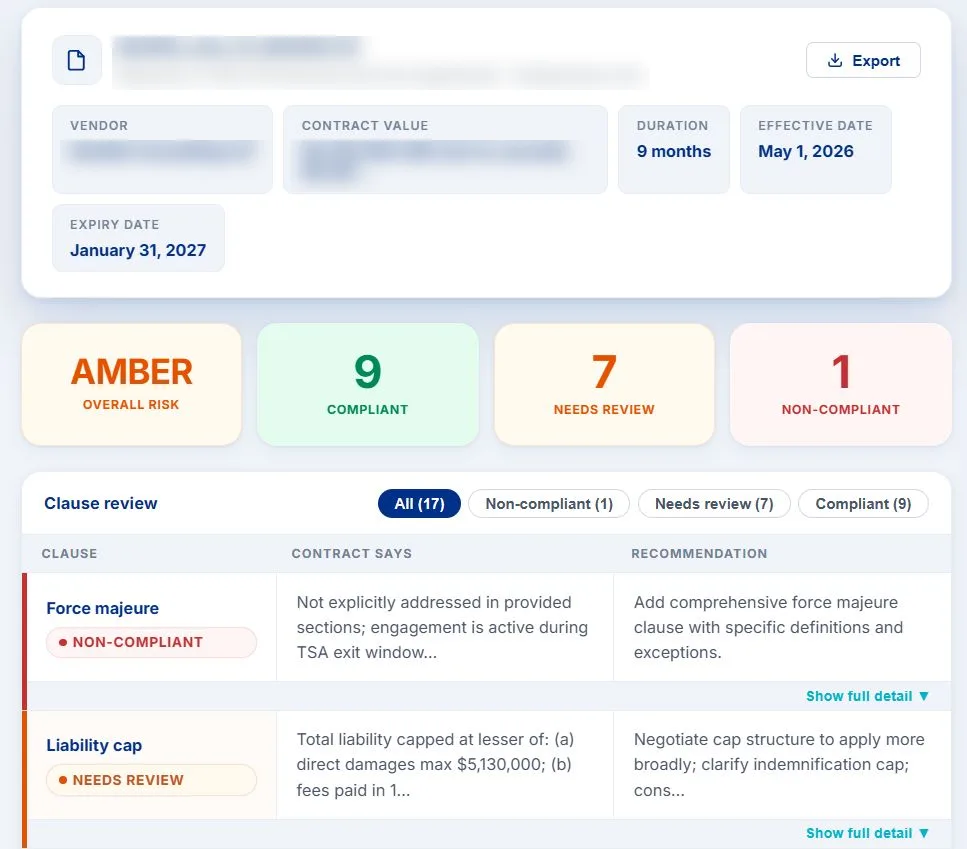
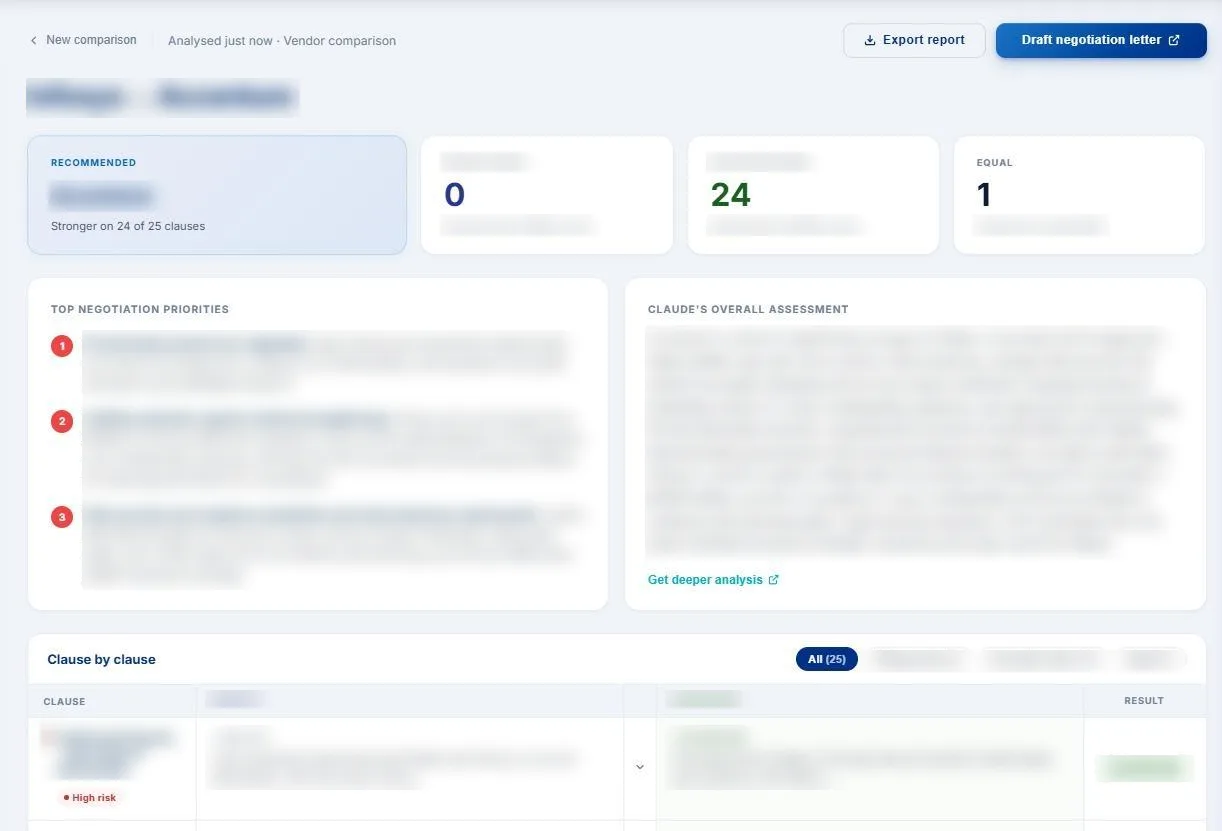
One system, three phases. Every line of code carries forward.
The prototype is built. Switch phases to see what each next step adds around it.
Who can open which contract?
Pick a person and a contract to see the hybrid access check.
Person (signed in with Azure AD SSO)
Contract
- Phase 1 (built): CloudFront, API Gateway, Lambda with FastAPI, Claude, encrypted S3 and Secrets Manager. Redeployable with AWS CDK in hours.
- Phase 2 (planned): Azure AD single sign-on, a Lambda authorizer, a DynamoDB access list, 5-minute presigned URLs, RDS PostgreSQL, and CloudTrail auditing of every access attempt.
- Phase 3 (planned): ECS Fargate (2–10 tasks), Multi-AZ RDS, ElastiCache, SQS and Textract OCR, with GuardDuty, Security Hub, Macie and blue/green deployments.
- No one touches S3 directly: documents are served only through short-lived presigned links, and every attempt, granted or denied, is logged.
No platform to roll out first
Traditional contract tools need a repository and integrations before they can help. This one starts from the document.
- No CLM or Ariba integration: it works directly from uploaded documents, so teams can start the same day.
- Structured, consistent scoring: every contract checked against the same 10-clause standard, every time.
- Three workflows in one place: validation, side-by-side comparison and conversational analysis share one document library.
- Fully serverless and long-form ready: handles contracts approaching 200 pages, with nothing for the client to manage.
What it delivers
Review turnaround
Each block = 1 working hour. Drawn to scale.
- Under one minute, down from two to three days.
- A 150-page document reviewed in under 35 seconds.
Consistent scoring
- Every contract, every clause: no clause overlooked because someone was rushed.
Faster escalation
Illustration based on the demo review above.
- Procurement flags the high-risk items, so legal reviews the exceptions, not page one.
- Contract novation and vendor transition management.
- CLM integration and procurement workflow automation.
- OCR for scanned contracts and legacy documents.
- Approval routing, workflow tracking and audit for legal, compliance and supplier teams.
A 60-second head start on every contract.
Faster vendor onboarding, lower legal costs and reduced contract risk, all from uploading a PDF.
- 01Your business objective
- 02The technical context
- 03The right next step